
Geo readiness check for uae business website
What this page covers
Geo readiness check for uae business website
A GEO readiness check reviews how easily Google and AI-powered search tools can crawl, understand, and reuse your website content. For UAE businesses, that matters as discovery increasingly happens through both classic search and AI search.
A structured check can show whether key answers are buried in PDFs or images, whether pages are exposed through sitemaps and internal links, and whether bilingual site setups create duplicate or incomplete indexing issues.
In brief
- A GEO readiness check is a structured review of crawlability, site structure, and content accessibility for Google and AI-powered search.
- It helps UAE businesses find hidden blockers such as weak internal linking, orphan pages, duplicate language paths, or important answers locked in hard-to-crawl formats.
- The goal is a practical snapshot of what to fix first so the website is easier for search engines and AI systems to discover and interpret.
What to do
A practical GEO readiness check starts with discovery. It reviews whether key pages are reachable through the sitemap and internal links, and whether important information is published in crawlable formats instead of being buried in PDFs, images, or other harder-to-process assets. It also checks technical factors that can indirectly affect crawling, such as slow performance or conflicting duplicate pages.
The next step is structure. The review looks for orphan pages, broken links, thin hubs, missing titles or headings, and other signals that make a website harder to understand. For many UAE businesses, this also means checking English and Arabic site setups, using clear language-specific hubs or subfolders, and applying hreflang correctly to reduce duplicate-content confusion.
The output should be a focused action list rather than a vague report. Typical next steps include updating the XML sitemap, fixing navigation and internal links so important pages sit under relevant hubs, and strengthening weak category or service hubs with better supporting links. After that, the site can be rescanned or resubmitted in Google Search Console to see whether coverage improves.
What to keep in mind
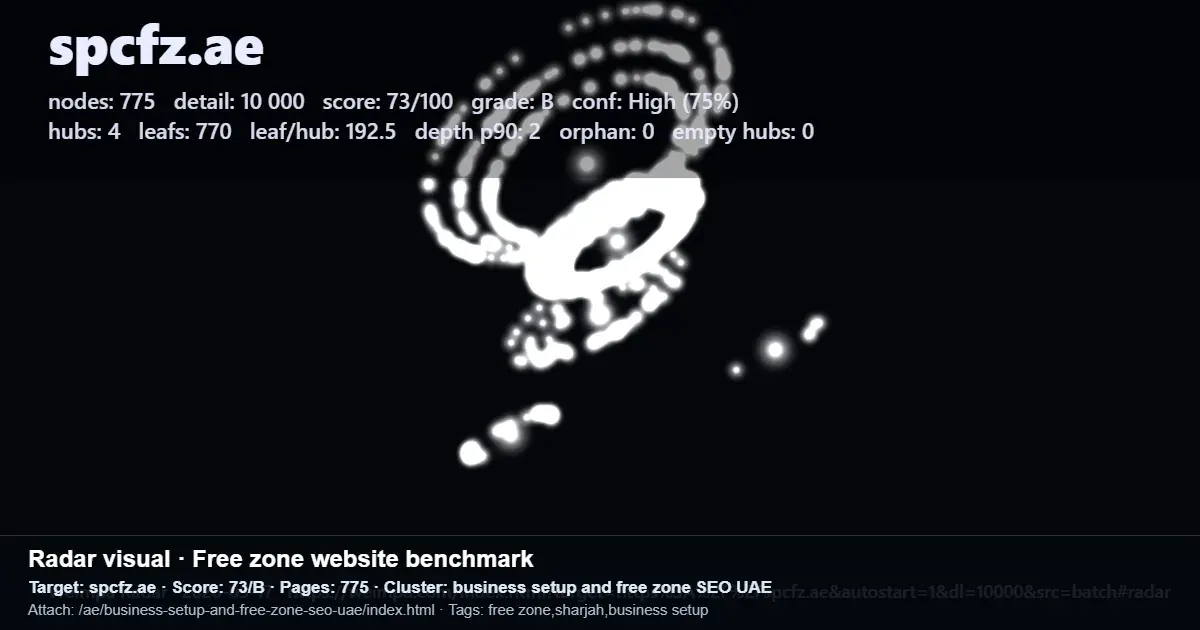
This approach is grounded in technical diagnostics and search visibility work for websites that need to be better understood by Google and AI-powered search. The first step described here is a free Radar scan, which checks how a public website is structured, which pages and hubs are visible, where discovery is blocked, and what should be fixed first.
It is especially relevant for UAE companies that depend on inbound discovery, including B2B services, real estate, clinics, SaaS, ecommerce, education, logistics, law firms, and agencies. The scan is most useful when a business already has a public website and needs clarity on structure, indexing, sitemap quality, or content accessibility issues.
If structural gaps are found, the follow-on work can extend into demand mapping, hub and leaf planning, evidence-backed English pages, internal linking, deployment, sitemap submission, and growth monitoring. That makes the readiness check a starting point for a broader search layer, not just a one-time diagnostic.