
It services and cybersecurity seo structure uae
What this page covers
It services and cybersecurity seo structure uae
Use this page as a starting point for planning how IT and cybersecurity services in the UAE should be structured for search, especially when buyers look for specific services and risk areas.
Radar benchmarks show that many cybersecurity sites in the UAE have few pages and weak structure, which creates an opportunity to improve how services are organised and discovered in Google and AI search results.
In brief
- Most UAE IT and cybersecurity firms depend on a few generic services pages, so Google and AI search cannot clearly see depth by risk, compliance topic, or industry.
- A hub-and-leaf structure that separates services, risks, compliance themes, sectors, and company sizes makes offers easier to discover, understand, and compare in search.
- With Radar, you can benchmark against UAE peers and design a scalable information architecture that avoids overlap while surfacing specialised cyber and IT offerings.
What to do
Radar shows that many UAE cybersecurity and IT providers run very thin site structures: a few hubs, a small number of leaf pages, and generic copy that tries to cover everything. This makes it hard for Google and AI search to understand which services you really offer, which risks you address, and which industries you support.
A stronger approach is to design a clear hub-and-leaf architecture for IT and cybersecurity. Hubs group content by service category (managed IT, SOC, incident response), risk theme (ransomware, data loss, cloud misconfiguration), compliance topic (ISO 27001, NCA, sector rules), industry, and company size. Each leaf page then focuses on one specific combination, with internal links that guide buyers from high-level hubs into deeper, specialised content.
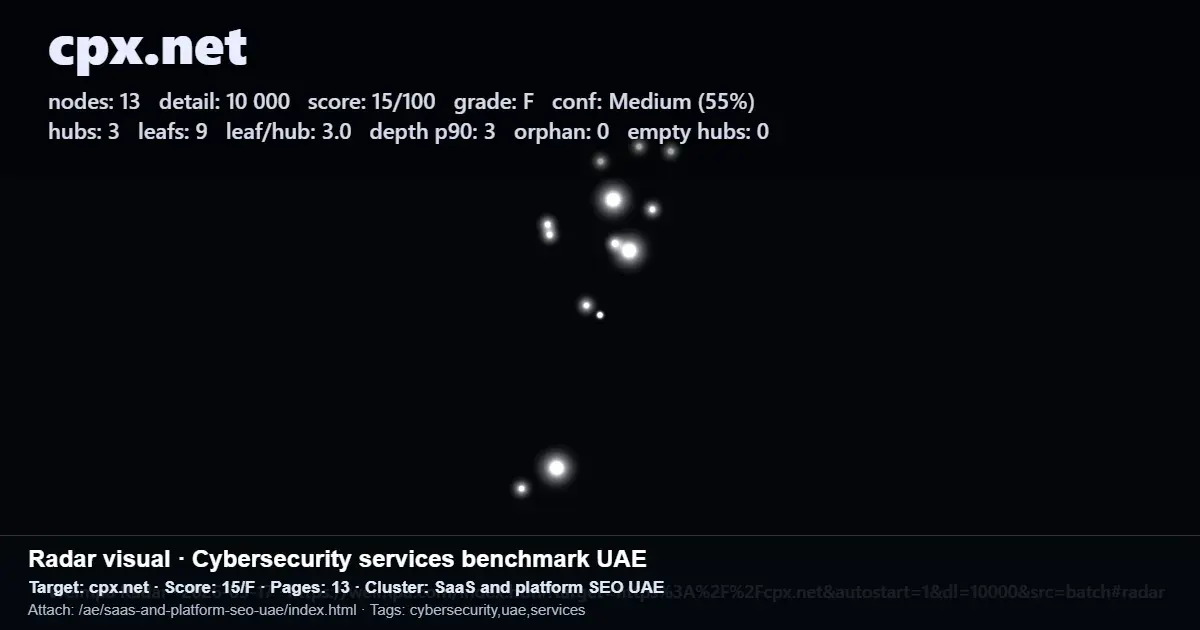
By mapping your current pages against UAE benchmarks such as cpx.net (small, low-detail structure) and larger professional-services sites with thousands of well-organised pages, Radar helps you see where you lack depth, where hubs are missing, and where content overlaps. You can then prioritise new pages and links that match real search demand for IT and cybersecurity in the UAE, instead of adding more generic solutions copy.
What to keep in mind
Radar benchmarks highlight that many UAE cybersecurity and IT sites have very few pages and shallow depth, which limits how well specialised services appear in search. If your site only has a generic IT services page and a basic cybersecurity overview, restructuring alone will not fix visibility without adding focused leaf content.
This hub-and-leaf model works best for IT, MSP, and cybersecurity firms that are ready to differentiate by risk, compliance topic, industry, and company size. If you only sell a single, undifferentiated service, a complex structure may add maintenance overhead without clear benefit.
The platform does not create demand; it shows how Google and AI search currently interpret your pages and how peers in the UAE are structured. You still need subject-matter experts to create accurate content for each risk and compliance area, and you should avoid duplicating near-identical pages that could compete with each other.
Larger professional-services sites in the UAE show that deep structures with thousands of pages can perform well, but they also require governance. Before scaling to that level, you should define clear rules for when to create a new hub or leaf, how to handle overlapping topics, and how to keep internal links aligned with real buyer journeys.