
Radar teardown of uae website
What this page covers
Radar teardown of uae website
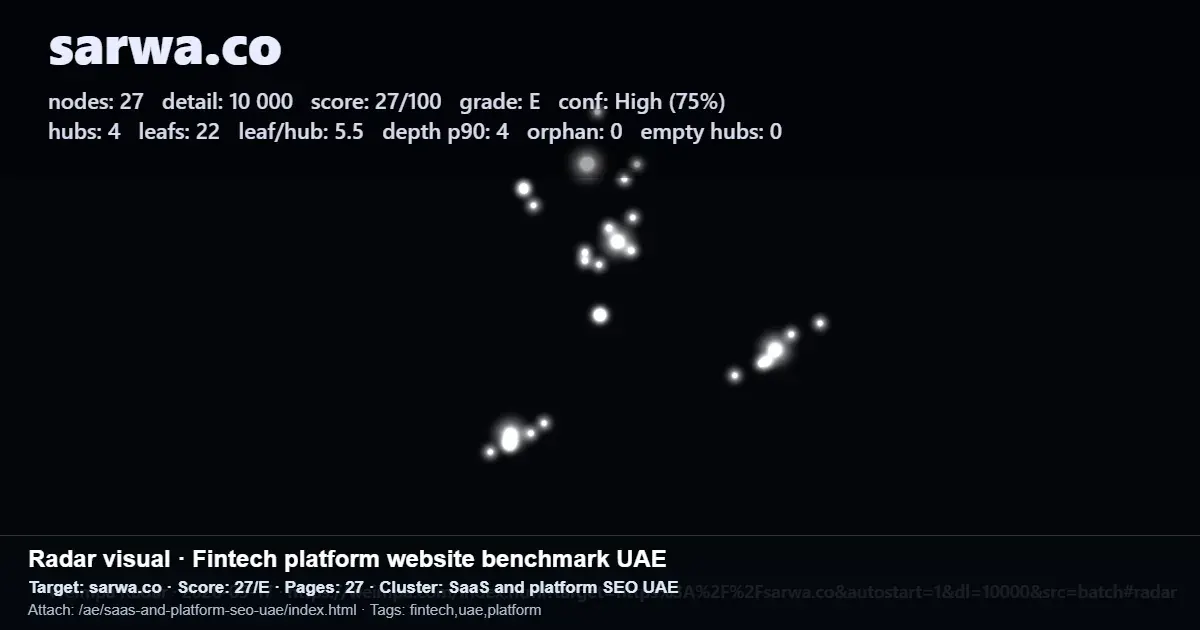
This Radar teardown looks at how selected UAE websites are structured from a crawler and graph point of view, using a visual site map and simple structural metrics.
You can use these benchmarks to see how many pages a site exposes, how hubs and leaf pages are balanced, and what that might mean for SEO and GEO readiness discussions with your team.
In brief
- Radar provides a visual site graph and headline metrics such as total pages, hubs, leaf pages, and depth, so you can see how a UAE website is actually structured.
- By comparing scores and grades across different UAE sites, you get a quick view of structural strengths and weaknesses to inform SEO, navigation, and GEO decisions.
- These public teardowns are designed as a simple, shareable diagnostic you can reference in internal or agency conversations about site structure and search readiness.
What to do
This teardown uses Radar to benchmark several UAE websites as graphs of nodes and connections. For each target, Radar reports the number of pages crawled, an overall score and grade, and how those pages are distributed between hubs and leaf pages. This gives you a compact snapshot of how the site is organised for discovery, navigation, and SEO/GEO diagnostics.
For example, the UAE news agency site wam.ae appears as a relatively large structure with 657 nodes and a strong overall score of 100 out of 100, graded A. Radar identifies 45 hubs and 611 leaf pages, with around 13.6 leaf pages per hub and a depth p90 of 3. This places wam.ae in the website structure audit cluster and highlights it as a solid media and government benchmark in the UAE context.
By contrast, the Dubai city portal dubai.ae is smaller, with 129 nodes and a score of 60 out of 100, graded C. Radar shows 5 hubs and 123 leaf pages, with about 24.6 leaf pages per hub and a similar depth p90 of 3. In the SaaS and HR space, bayzat.com in the UAE scores 68 out of 100, also graded C, with 305 nodes, 4 hubs, and 300 leaf pages, and no reported orphan or empty hubs. Together, these examples show how Radar teardowns surface structural patterns across authority, media, and SaaS sites in the region.
What to keep in mind
The focus of this teardown is on public, crawlable structure rather than on-page content quality or conversion performance. Metrics such as node count, hubs, leaf pages, and depth are drawn from Radar’s crawl and are intended to show how the site looks from a technical discovery perspective, not to provide a full SEO or GEO audit on their own.
Because each site sits in a different cluster, comparisons should be read in context. Wam.ae, with 657 pages and a 100/A score in the website structure audit cluster, represents a media and government benchmark, while dubai.ae, at 129 pages and 60/C in the radar teardowns and benchmarks cluster, reflects a different authority portal profile. Bayzat.com, at 305 pages and 68/C in the SaaS and platform SEO UAE cluster, is an HR SaaS example rather than a government reference point.
These teardowns are most useful if you need a clear, shareable picture of how a UAE website is wired for discovery and navigation, and a starting point for structural next steps. They are less suited to answering detailed questions about content strategy, analytics, or user experience, which would require additional tools and analysis beyond the structural view provided here.