
Radar Scan vs Traditional SEO Audit for UAE Websites
What this page covers
Radar Scan vs Traditional SEO Audit for UAE Websites
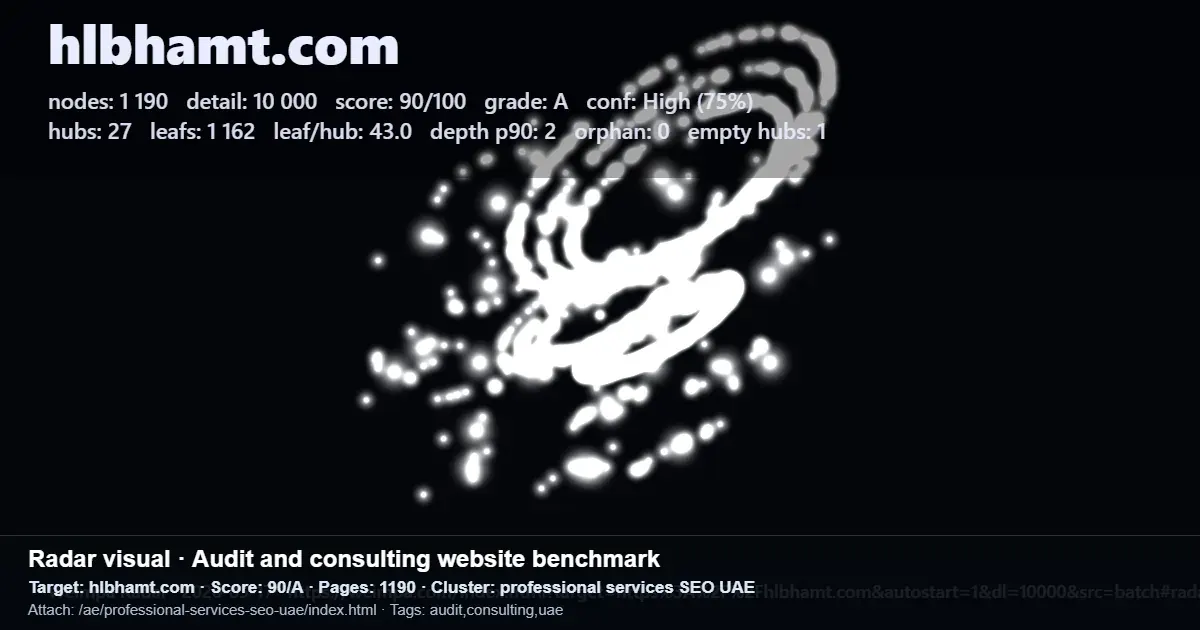
Radar is a fast structural scan for public websites in the UAE. It shows visible pages, hubs, leaves, weak spots, and where search discovery appears blocked.
A traditional SEO audit supports a broader review. Radar works best as a practical first diagnostic that turns structural issues into clear next actions.
In brief
- Radar focuses on visible site structure and action-led findings such as missing hubs, orphan leaves, and shallow content clusters.
- It checks public website elements including pages, hubs, leaves, weak spots, sitemap, robots, and homepage access, then highlights practical next steps.
- Radar does not scan sites behind logins, paywalls, or strong bot protection. In those cases, a URL snapshot can be visualised through JSON import.
What to do
Choose Radar when your main question is what search engines and AI-powered search can currently see on a public website. It is designed to surface structural gaps quickly and turn them into concrete fixes, instead of leaving the team with a broad audit that is harder to prioritise.
For UAE companies, marketers, SEO teams, agencies, and digital platforms, Radar works as a first diagnostic layer. It checks how a site is structured, which pages and hubs are visible, where discovery is blocked, and what should be fixed first across issues such as weak entry points and sitemap quality.
If the scan shows missing structure, the next step can move into building the search layer around demand mapping, hub and leaf planning, evidence-backed pages, internal linking, deployment, sitemap submission, indexing support, and growth monitoring.
What to keep in mind
Radar is most useful for public websites where the immediate need is clarity on structure, discovery, and visible search readiness. Its output is practical and action-oriented, with issues such as missing hubs, orphan leaves, and shallow clusters clearly flagged for follow-up.
A traditional SEO audit may be a better fit when a team needs a wider custom review beyond structural scanning. Radar is centred on public site scans, graph-style structure visibility, readiness scoring, and practical next steps rather than trying to cover every audit angle.
There are clear operating limits. Radar does not scan websites behind logins, paywalls, or aggressive bot protection. When direct scanning is not possible, a team can provide a URL snapshot and use JSON import for visualisation instead.