
How a Radar Scan Checks a UAE Website Structure
What this page covers
How a Radar Scan Checks a UAE Website Structure
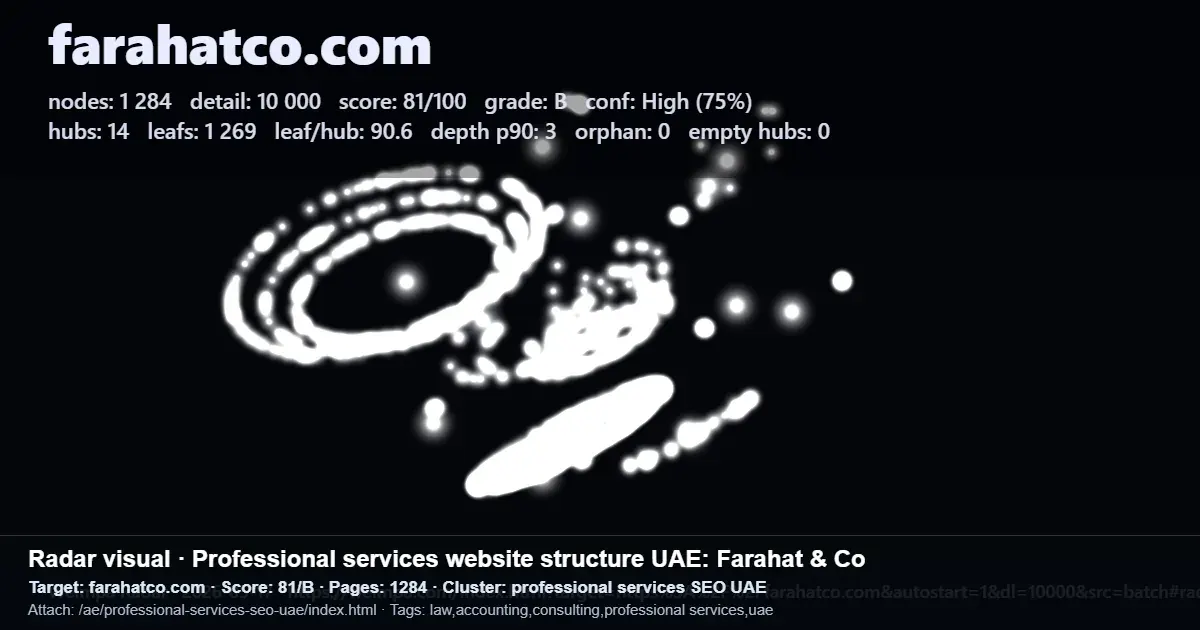
A Radar scan reads a UAE website as a structure, not just a list of URLs. In the visible examples, it reports nodes, hubs, leaf pages, leaf-to-hub ratio, depth, orphan pages, empty hubs, score, grade, and confidence.
The same scan format appears across UAE examples, including real estate and professional services sites. Readable samples range from 90 pages to 5,052 pages, with grades from D to B and confidence levels that vary by site.
In brief
- It counts the total visible pages or nodes, then separates hubs from leaf pages so the site structure is easier to understand.
- It checks structural signals such as leaf-to-hub ratio, depth p90, orphan pages, and empty hubs where those values are available.
- It summarises the scan with a score, grade, and confidence level, as shown in multiple UAE website examples.
What to do
A Radar structure scan starts by making the site measurable. In the available UAE examples, one site shows 90 pages, another 109, another 496, another 1,116, and another 5,052. That gives a quick view of scale before a deeper review.
The scan then shows how those pages are organised. Readable examples include 3 hubs with 105 leaf pages, 13 hubs with 482 leaf pages, 16 hubs with 1,099 leaf pages, and 12 hubs with 5,039 leaf pages, along with leaf-to-hub ratios.
It also adds structure quality signals. The visible examples include scores and grades such as 48/D, 58/C, 79/B, 80/B, and 82/B, plus confidence readings and checks for depth, orphan pages, and empty hubs where those fields are visible.
What to keep in mind
A Radar scan works well as a fast structural read. Based on the examples, it helps show whether a site’s visible pattern is mainly about scale, hub coverage, leaf distribution, depth, orphan pages, or empty hubs.
The examples also show why page count alone does not explain structure quality. A 109-page site appears with a 58/C score, while a 496-page site appears with an 80/B score and a 1,116-page site appears with an 82/B score.
Confidence should be read carefully. Some examples show higher confidence around 75% to 78%, while others are closer to 45%, so the scan is best used as a structured starting point rather than a full technical audit.