
Uae competitor website structure analysis
What this page covers
UAE competitor website structure analysis
Compare your website structure with visible UAE competitors by reviewing their key section URLs, sitemap patterns, hubs, and leaf pages.
Use the comparison to see which topics competitors support with dedicated pages, so architecture decisions are based on observable gaps rather than guesswork.
In brief
- Review competitor sitemaps and main section URLs to see how they group services, information pages, and search topics.
- Look for important queries that competitors answer with dedicated hubs or leaf pages while your site only mentions them briefly.
- Use the findings to plan missing hubs, new leaf pages, clearer navigation, and stronger internal linking.
What to do
A useful UAE competitor website structure analysis starts by listing the main sections of competitor sites through SEO tools, public sitemaps, or manual navigation review. The aim is not to copy another website, but to understand how visible competitors organise content, services, and search entry points.
The next step is gap mapping. If a competitor has a full section for a topic while your website only has a short overview, that may point to a missing hub or leaf page. Reviewing which queries competitors support with dedicated pages turns structural discussion into a clearer content plan.
The review should also include practical audit signals such as crawl checks, click depth, navigation, and internal link distribution. These checks show whether a competitor’s architecture is broad, shallow, deep, or concentrated around specific hubs, giving your team a stronger basis for restructuring decisions.
What to keep in mind
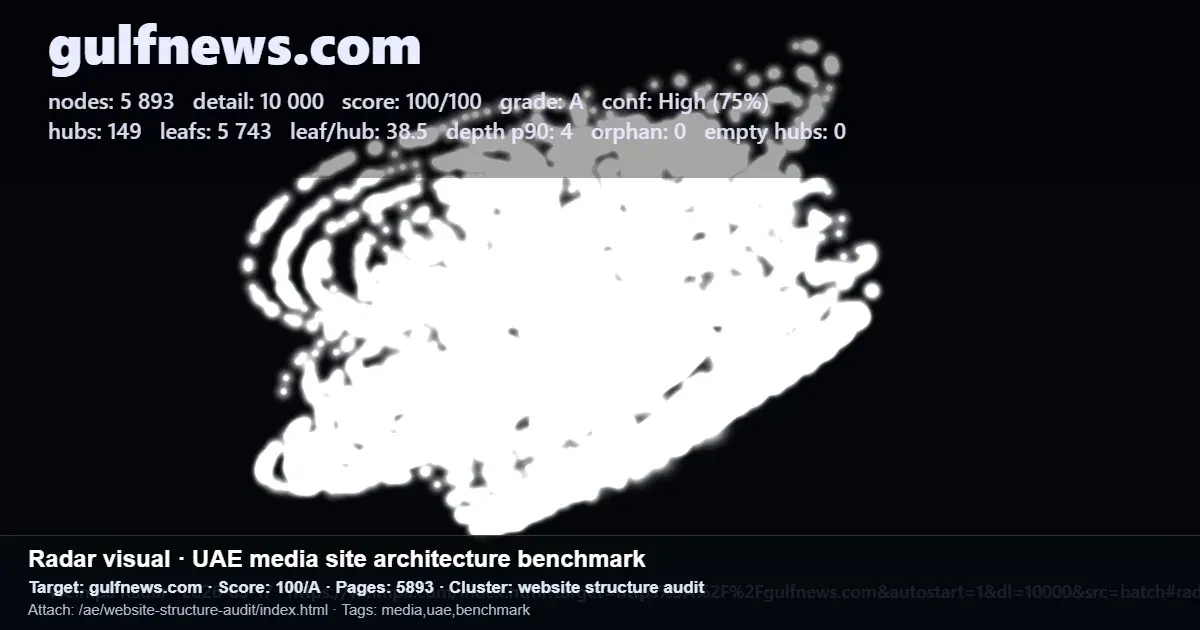
UAE benchmark data can show very different public site structures. One culture portal benchmark lists 14 pages, 2 hubs, 11 leaf pages, and a 25/E score, while a UAE media site benchmark lists 5,893 pages, 149 hubs, 5,743 leaf pages, and a 100/A score.
These comparisons are useful, but they need context. A large media domain and a smaller authority or service website should not be judged by sitemap size alone. The value is in seeing structural patterns, not assuming that more pages or more hubs are always better.
Competitor structure analysis works best when it is paired with your own goals, services, and content priorities. Public sitemaps and crawls can reveal visible architecture, but they cannot explain every business decision behind it, so the findings should guide planning rather than replace strategy.