
IT Services or Cybersecurity Marketing Lead in UAE
What this page covers
IT Services or Cybersecurity Marketing Lead in UAE
If you lead marketing for an IT services or cybersecurity company in the UAE, your website may cover many services, risks, technologies, and sectors, but still lack clear entry points for buyers.
A practical first step is to run Radar, review your current structure, and see which service, risk, industry, or company-size pages need clearer hubs before you add more content.
In brief
- You may need a clearer search structure around IT problems, cybersecurity risks, services, industries, and company-size scenarios, so buyers land on pages that match their situation.
- A structured Radar review or benchmark-style audit can help you check hubs, leaf pages, depth, clusters, and AI or GEO search readiness before expanding the site.
- Before you build more pages, check whether the real issue is missing demand coverage, weak architecture, overlapping pages, or not enough useful service-led content.
What to do
For an IT services or cybersecurity marketing lead, the challenge is often not a lack of topics. Services, solutions, technologies, risks, and industries can become mixed together, making it harder for UAE buyers to find the right entry point.
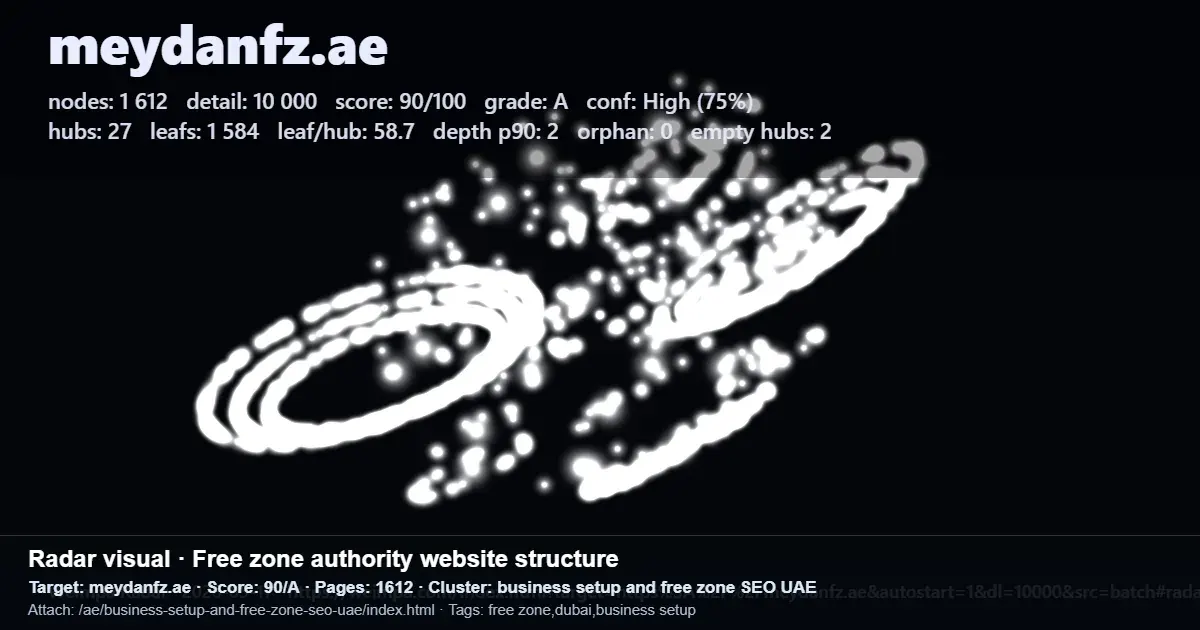
Radar may fit when you need a structured view of your website architecture: hubs, leaf pages, page depth, clusters, and how service pages can work as entry points for Google and AI-powered search. The review can focus on solution pages, service pages, industry pages, risk-led pages, or company-size scenarios, depending on what your site already has.
A careful start is to avoid launching many new landing pages at once. First review the current structure, identify weak hubs or missing leaf coverage, and choose a small set of pages where clearer UAE search coverage has a practical reason.
What to keep in mind
Radar-style UAE benchmarks look at real site structures using signals such as page count, hubs, leaf pages, depth, clusters, and scores. These signals can support prioritisation, but they do not guarantee rankings, traffic, or lead growth.
This approach is most useful when the problem is structural: unclear service entry points, thin or overlapping pages, weak hubs, or difficulty justifying new content around sectors, risks, and company-size needs. It is less relevant if you only need campaign copy or a one-off article.
The next step is reasonable because it creates evidence before content expansion. Instead of guessing which IT services or cybersecurity pages to build, you can first see how your site is organised and where a clearer SEO and GEO structure may be needed.