
Radar SEO Audit Workflow for UAE Websites
What this page covers
Radar SEO Audit Workflow for UAE Websites
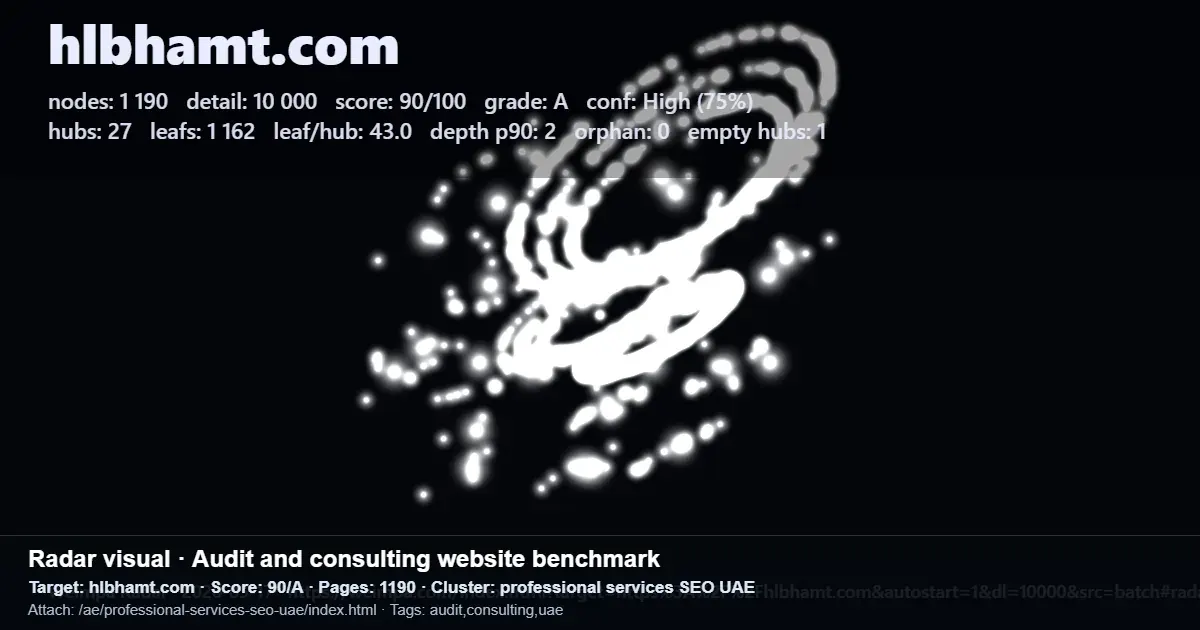
Radar gives UAE website teams a structured way to review site architecture. It starts by checking robots.txt, finding sitemap files, reading the listed URLs, and turning them into a visual site graph.
If sitemap discovery is incomplete, Radar can fall back to a shallow crawl within fair use limits. This helps teams spot structural issues early before moving into deeper technical SEO work.
In brief
- The workflow starts with sitemap discovery through robots.txt, then reads sitemap URLs to map the site's structure.
- It helps surface practical fixes such as improving sitemap coverage, removing orphan pages, and tightening hub-to-leaf navigation.
- If a full sitemap path is not available, the scan can continue with a shallow crawl to provide an initial structural view.
What to do
A grounded Radar SEO audit workflow starts with what a website already exposes publicly. Radar first tries to discover sitemaps through robots.txt, then reads the sitemap URLs and turns them into a site graph. This gives teams a quick view of how hubs, leaves, and clusters are currently organised.
From that graph, the workflow becomes practical. Clear fixes often include improving sitemap coverage, removing orphan pages, and making hub-to-leaf navigation more consistent across important sections. For UAE websites, this helps show where key pages exist but are weakly connected or not clearly surfaced.
If sitemap discovery does not fully work, the process does not stop. Radar can fall back to a shallow crawl, within fair use limits, to produce an initial structural diagnostic. That makes it useful for early audits, triage, and prioritising the next technical SEO tasks.
What to keep in mind
This workflow is strongest for structure-level diagnostics, not broad promises. The evidence supports sitemap extraction, graph building, shallow crawl fallback, and structural fixes around coverage, orphan pages, and hub-to-leaf navigation. It does not support claims about rankings, traffic growth, or full remediation on its own.
The available example is a UAE education website benchmark showing a Radar visual with a score of 57 out of 100, grade C, 78 pages, 5 hubs, 72 leaves, and high confidence noted in the scan. That shows the kind of output a team can review when assessing site structure in a UAE context.
It can also suit agencies that want a repeatable audit layer for proposals or client diagnostics, especially when they need consistent structural scans. Still, the clearest grounded use case is checking sitemap, indexing, and internal structure patterns before making deeper technical SEO decisions.