
Free Radar scan vs SEO audit for UAE websites
What this page covers
Free Radar scan vs SEO audit for UAE websites
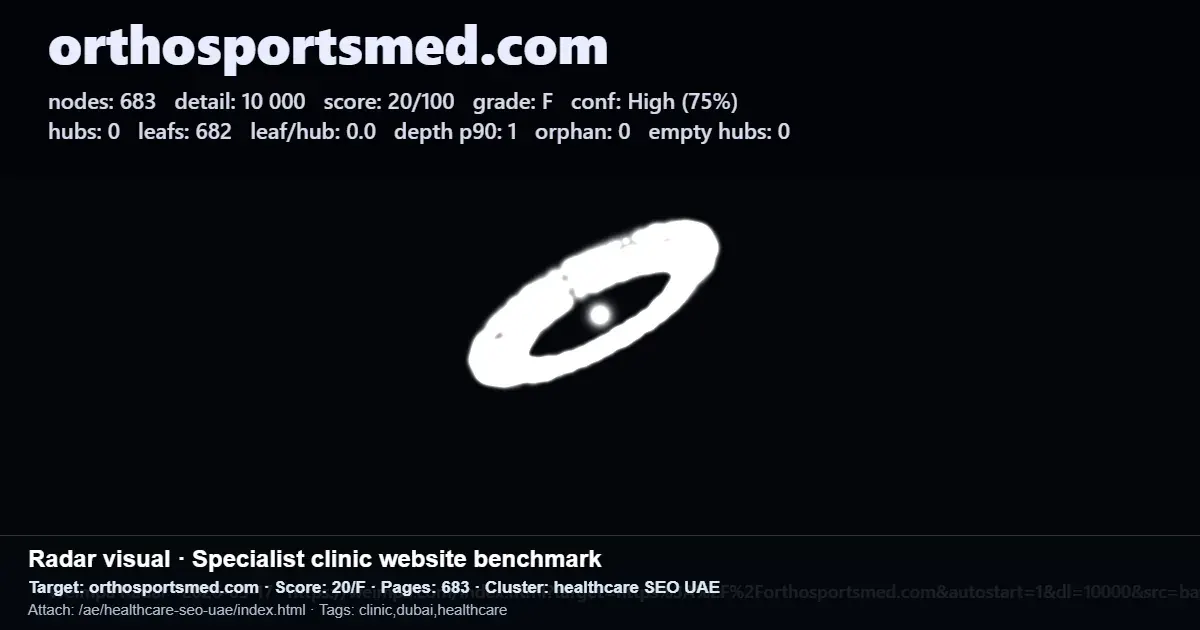
A free Radar scan gives you a quick structural snapshot of a UAE website. It shows page volume, hub-and-leaf distribution, depth signals, and an overall score or grade.
An SEO audit is usually the deeper next step. If the scan shows uneven structure, too few hubs, or weak page distribution, the audit explains the issues in more detail and turns them into a clearer action plan.
In brief
- Radar is useful when you need a fast benchmark. In the examples here, UAE sites range from 65/C on 265 pages to 99/A on 1,640 pages.
- The scan is especially helpful for comparing structure patterns such as hubs, leaf pages, total page count, and overall score across websites in the same UAE cluster.
- A full SEO audit makes more sense after the scan when you need deeper explanation, more formal reporting, or a clearer way to present findings to decision-makers.
What to do
If you are choosing between a free Radar scan and a full SEO audit, start with the scan when the main question is basic website structure. The UAE examples make this practical: one site scores 99/A with 38 hubs and 1,601 leaf pages across 1,640 pages, while another scores 73/B with 4 hubs and 770 leaf pages across 775 pages. That kind of comparison helps teams spot structural gaps quickly.
A scan is also useful when you want a benchmark within a specific UAE search cluster. The examples here sit in the business setup and free zone SEO UAE cluster, which makes score, page count, and hub-to-leaf patterns easier to compare on similar terms. For a team reviewing several sites, this is a practical first pass before deciding where deeper work is worth the time.
Choose the audit when the goal shifts from benchmarking to explanation and action. The supporting material points to common needs such as standardizing reports, making technical findings easier for non-technical stakeholders to follow, and showing before-and-after improvement in structure and indexing. In that sequence, Radar is the quick diagnostic layer, and the audit is the deeper review.
What to keep in mind
This page is most useful for UAE teams that need a quick structural read before spending more time on manual review. It fits cases where the question is whether the site has enough hubs, how leaf pages are distributed, and how one website compares with another in the same market cluster.
It is less useful if you expect a scan on its own to replace a detailed audit. The supporting material describes audits as more time-consuming to prepare, but valuable when teams need packaged findings, consistency across reviewers, and a clearer diagnostic for prospects or stakeholders. That suggests the scan is a starting point, not a full substitute.
The examples on this page are specific to UAE free zone and business setup websites, including scores such as 65/C, 73/B, and 99/A with different page totals and hub counts. These figures are useful for directional comparison, but they should be read as structural benchmark signals rather than a full review of every SEO factor.